AI-Generated Affective Scent — hero

2025 · Harvard · Advised by Prof. Rosalind Picard & Prof. Paul Liang

AI-Generated Affective Scent

Affective Computing · Multimodal AI
Multisensory · Human Factors Research

Role: IRB, System Design, Multimodal Pipeline Architecture, User Study Design

LLM inspired AI Olfactory and Computational Scent Generation for Racing Simulation Performance with Personalization in Real Time.

This research project was developed under the advisory of Media Lab Prof. Rosalind Picard and Prof. Paul Liang. We investigated olfaction as a novel intervention channel for affective state modulation in autonomous and semi-autonomous driving contextsm more specifically, racing simulations scenarios.

The core proposition is that an AI system infers the driver's emotional and cognitive state in real time from multimodal inputs, including physiological signals, visual scene analysis, and behavioral indicators, and generates a personalized scent prescription to shift affect toward more focused and more attentive states. The system design employs a VLM, coupled with an LLM-inspired scent generation module that maps emotional states to olfactory profiles.
AI Systems

Vision-Language Model (VLM)LLM Reasoning PipelineMultimodal Fusion

Inputs

Physiological SignalsVisual Scene ContextBehavioral Indicators

Output

Real-time Scent PrescriptionEmotional State Inference

Research Background

Research Background


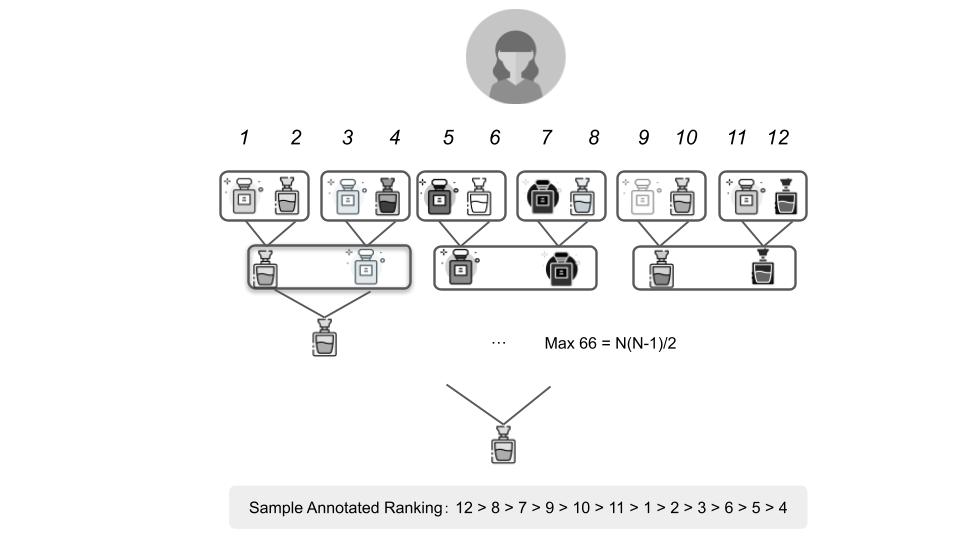
Scent sequence diagram

Scent is the only sense with a direct anatomical pathway to the limbic system — the brain's seat of emotion and memory. Yet it remains almost entirely absent from the computational interfaces that increasingly mediate human experience. This project asks what it would mean to give AI an olfactory voice, as a considered affective intervention in one of the most cognitively demanding environments humans routinely occupy: driving.

Methods

Methods


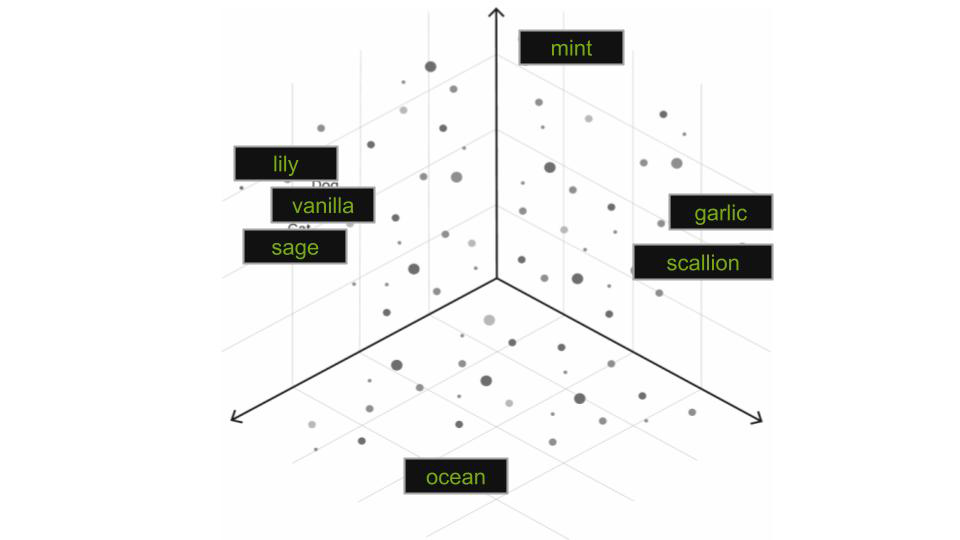
Embedding space visualization

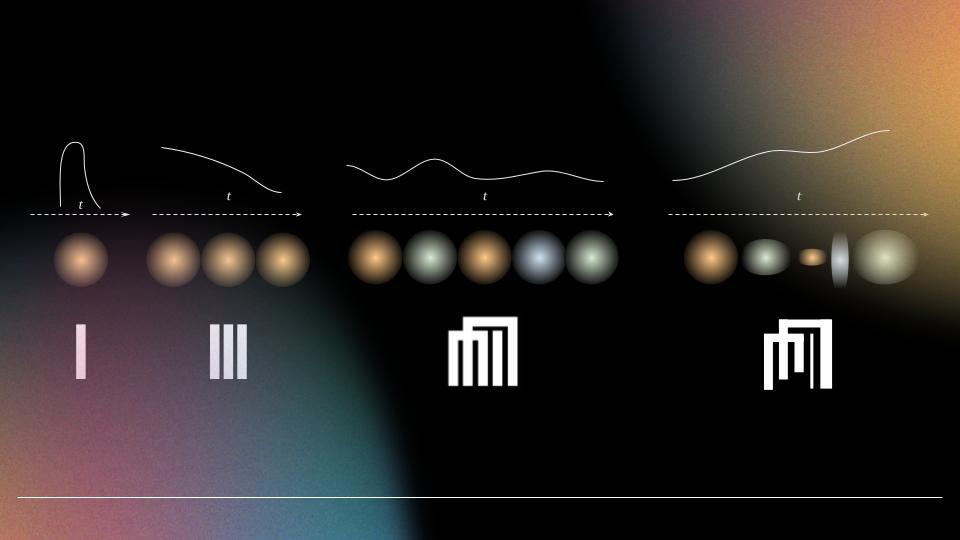
Inspired by transformer models that generate sequences of words using LLM and embedded space, we developed AI Sequenced Scent — a new terminology applying the same generative logic to olfactory composition.

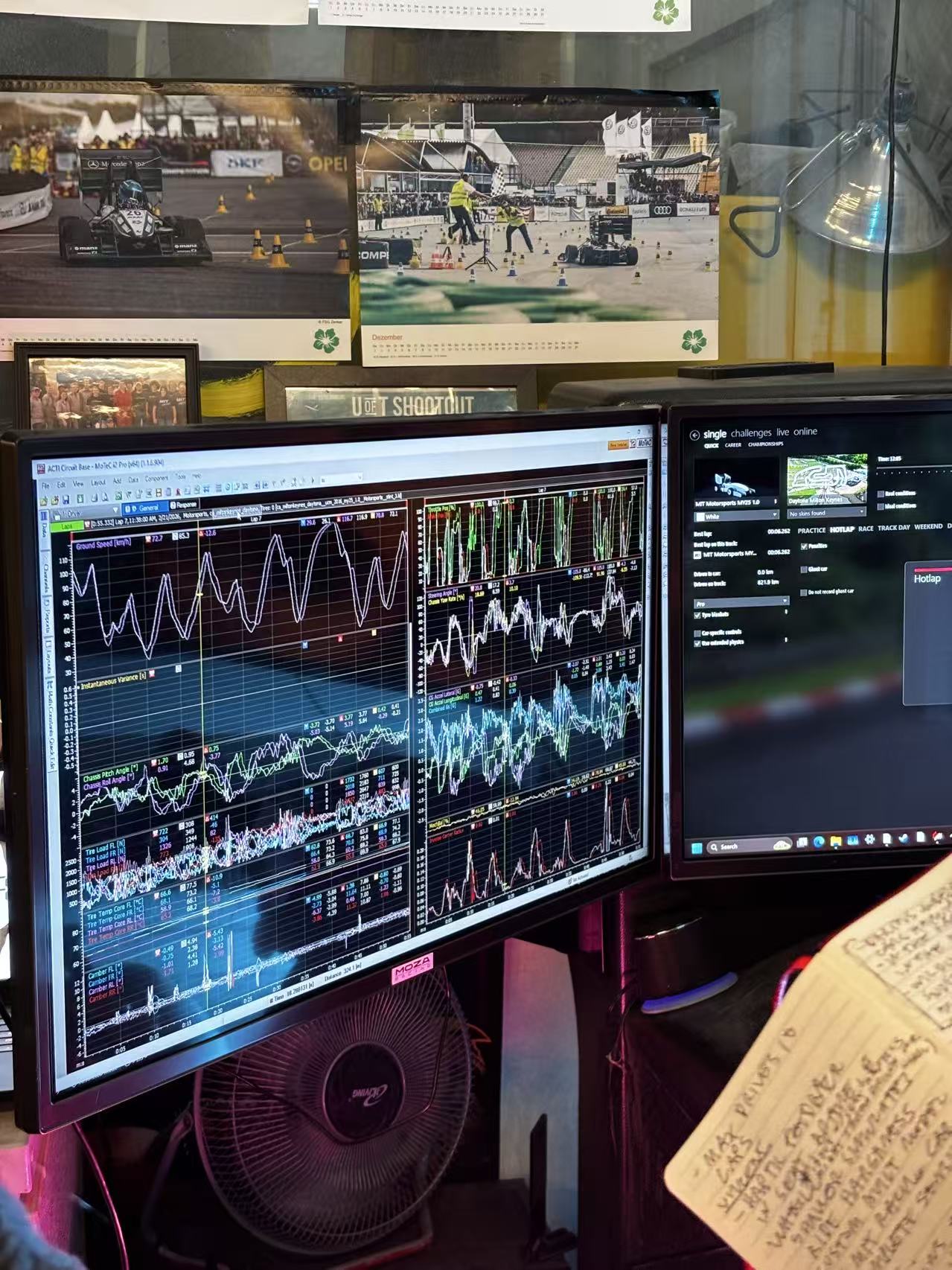
In our study, participants drove in a racing simulator with and without scent interventions. We built personalized scent sequences based on each participant's preference ranking. Rather than a single static smell, we designed dynamic scent sequences that could adapt over time.

System

System Pipeline


Multimodal reasoning pipeline

Sensing & Context

  • Physiological inputs: heart rate, skin conductance, and facial expression as affective proxies
  • VLM processes front-facing camera feed for scene complexity, hazard density, and behavioral cues

Affective State Inference

  • Multimodal fusion produces a continuous emotional state estimate along arousal-valence dimensions
  • Context-aware weighting privileges physiological signals under high-hazard driving conditions

Scent Generation

  • LLM-inspired module maps emotional state to olfactory profiles drawn from psychophysical literature
  • Prescriptions target anxiety reduction, arousal normalization, or attentional refocusing depending on detected state

Full Report

Read the Research

A comprehensive technical report covering the system architecture, affective computing pipeline, experimental design, and speculative implications of AI-mediated olfactory intervention in autonomous driving contexts.

AI-Generated Affective Scent — Research Slides Loading…
Research slide

Academic Paper

Research Paper

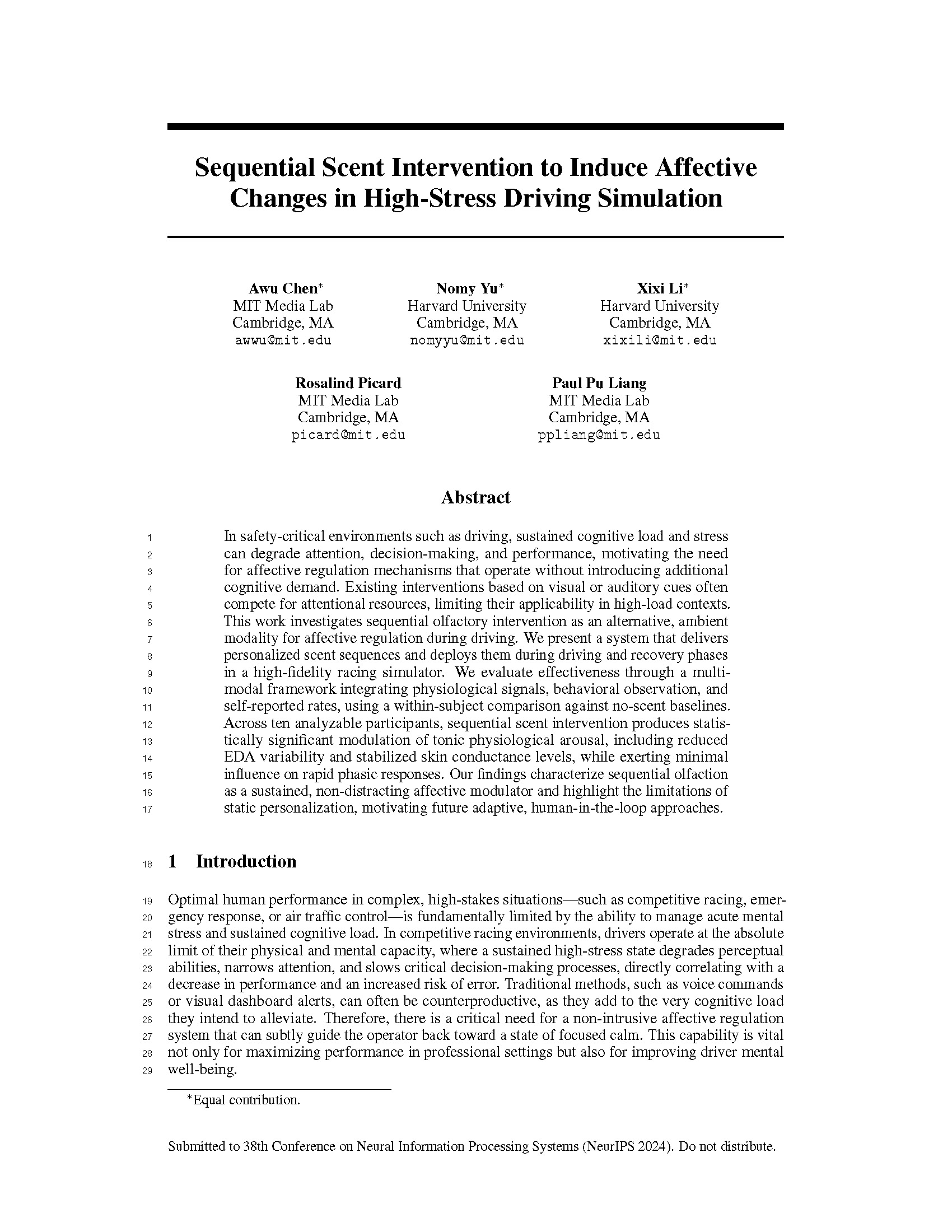
Paper preview
Request Access ↗

Under Review

Affective Scent Intervention:
AI-Mediated Olfactory Modulation
for Driver Safety

Research on real-time emotional state inference and personalised scent prescription to improve driver safety in autonomous driving contexts. Advised by Prof. Rosalind Picard and Prof. Paul Liang.

Request Access ↗

Acknowledgements

Instructors

Prof. Rosalind Picard
Media Lab Affective Computing Group

Prof. Paul Liang
Media Lab Multisensory Group

Special Thanks

MIT Motorsports Team  ·  Max Esterson  ·  Brett Berk  ·  Vincent Xiao

Interviewed and published on Road & TrackResearch: If Smell Makes Drivers Faster

← Overview All work Next Project →